Illinois Agronomy Lab
A go-to source for the latest research and agronomic information for field crops in Illinois
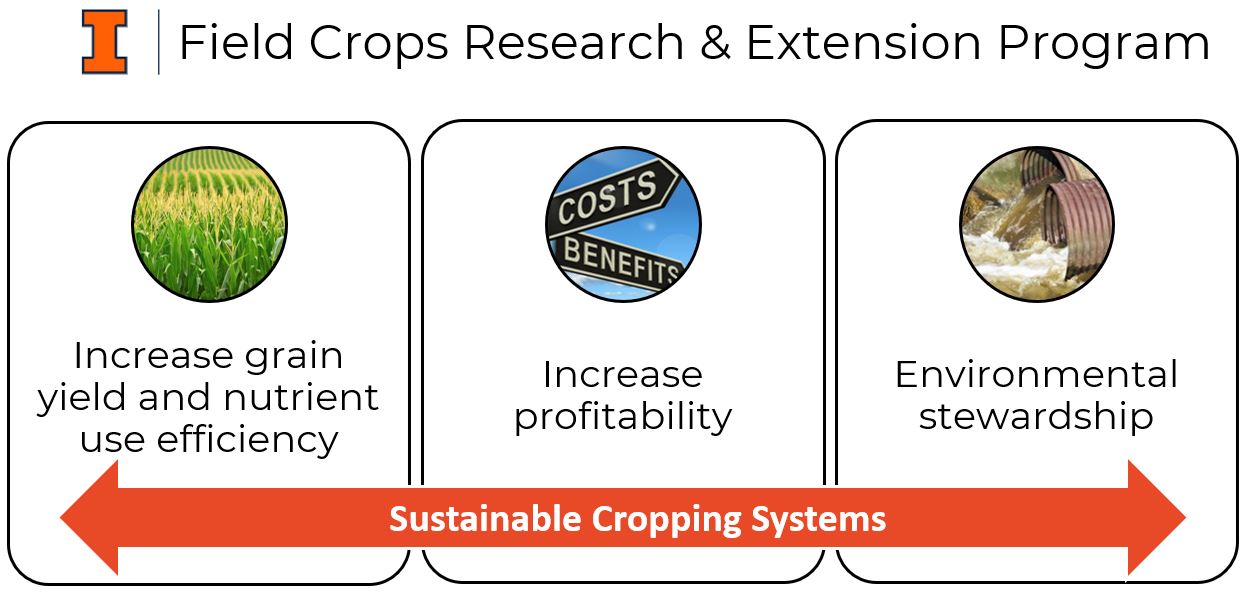
A major focus of the Illinois Agronomy Lab is exploring ways to advance the productivity and environmental performance of row-crop systems in Illinois and the upper Midwest. To do it, our team takes an interdisciplinary approach to document and understand the implications of a variety of in-field conservation practices (e.g., 4R nutrient stewardship, cover cropping, and conservation tillage) on crop productivity and profitability, soil and water quality, greenhouse gas emissions, and nutrient losses. This knowledge is then integrated and delivered through our Extension program.

Find Resources
Here you can find information and crop management in Illinois
Crop Performance Trials
Looking for information on crop performance to help you select suitable hybrids and varieties? Check out the University of Illinois Variety Testing trials here.
From the Blog:
The 2025 growing season in Illinois delivered another storyline characterized by sharp weather contrasts, average crop condition ratings, some disease pressure in places, and very good — if not record-setting — yields in many, but not all, areas. As we have seen before, crops showed their ability to translate good mid-season conditions to good yields…
This project aimed to evaluate whether growers can maintain productivity and profitability while using reduced tillage and cover crops, systems that protect soil but are often perceived as risky. A second objective was to understand whether starter fertilizer (nitrogen + sulfur) could offset early-season challenges in these systems, such as cool soils, heavy residue, and…
There is a growing interest in wheat/soybean double-cropping systems in Illinois, extending into parts of central Illinois where wheat acreage has been limited in recent decades. This article summarizes findings from field trials evaluating management practices for double-crop soybean in central Illinois
While August rainfall is the “soybean maker,” July rainfall is also important to the podsetting process that sets up yield potential. July rainfall was plentiful overall in Illinois, but varied from an inch or two less than normal in parts of southern Illinois to more than twice normal amounts in western and northwestern Illinois…
It was no surprise to see the 2025 corn yield projected at 222 bushels for Iowa, but it was surprising to see 221 bushels projected for Illinois. Ihe US yield is predicted to be 188.8 bushels per acre, 9.5 bushels higher than the previous yield record, set in 2024. So, while 2025 is set to…
With high yield potential and with seed high in protein (38–40%), the soybean crop requires a lot of N—roughly 4.5 lb of N per bushel, with about 3.5 lb of that removed with the grain. A 60-bushel soybean crop (similar to the current Illinois average) would need approximately 270 lb of N per acre, while…